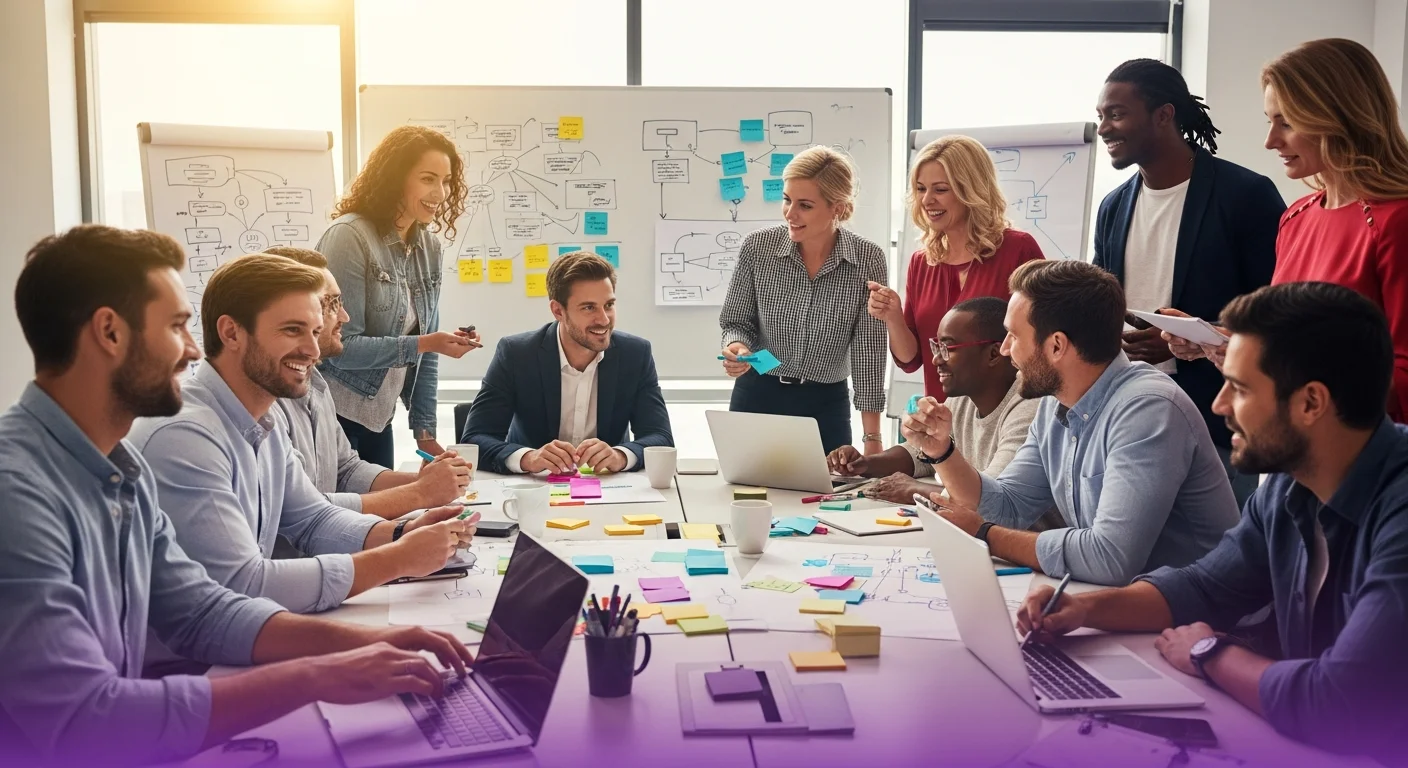
The Ultimate Team Alignment Workshop Guide for Modern Leaders
15

Misalignment is the silent killer of team velocity, often costing organizations up to 13% of their total work time in wasted effort. This guide provides a structured roadmap to synchronize your team's goals, roles, and processes using modern facilitation techniques and AI support.
Topics covered in this article
Alignment is a continuous practice, not a one-time event; regular workshops are essential to maintain velocity.
Use AI-powered tools to handle the logistics of agenda creation and live facilitation, allowing you to focus on the team's needs.
Visual frameworks like the Sailboat or Impact/Effort Matrix are critical for making invisible friction points visible and solvable.
In high-growth environments, the distance between a leader's vision and a team's daily output can grow dangerously wide. Recent data from 2025 suggests that while 27% of leaders believe their staff is fully aligned with business goals, only 9% of employees agree. This disconnect leads to duplicated work, conflicting priorities, and a measurable drop in morale. At TeamLube, we believe that alignment is not a one-time event but a continuous practice. This guide provides the frameworks and activities needed to run a high-impact team alignment workshop that transforms vague objectives into a unified plan of action, ensuring your team moves with clarity and confidence.
The High Cost of Misalignment in 2026
Misalignment is no longer just a minor friction point; it is a significant financial and operational risk. Research from 2025 indicates that highly aligned companies grow revenue 58% faster and are 72% more profitable than their unaligned peers. Conversely, poor communication and lack of clarity are responsible for approximately 28% of project delays. When team members are pulling in different directions, the result is a 'velocity trap' where everyone is working hard, but the organization is standing still.
The modern workplace, characterized by hybrid models and rapid AI integration, has made traditional alignment methods obsolete. Managers now spend an average of 10 hours per week providing updates that often fail to resonate. This is because updates are not the same as alignment. While an update tells people what happened, alignment ensures they know what to do next and why it matters. Without a dedicated space to synchronize, teams often fall into silos, where departmental goals take precedence over the company's North Star metric.
At TeamLube, we see this gap as an opportunity. A well-executed alignment workshop can reduce turnover by 25% and increase productivity by 21%. By bringing the team together to address the 'Alignment Spectrum,' you make invisible friction visible. This allows you to solve conflicts before they become bottlenecks, ensuring that every hour spent working is an hour spent moving toward your primary objectives.
Defining Your Team Alignment Workshop Objectives
The success of any workshop is determined before the first participant joins the call or enters the room. A common mistake is hosting an alignment session without a specific, measurable outcome in mind. To avoid this, you must define exactly what 'alignment' looks like for your specific context. Are you aligning on a new quarterly strategy, resolving role confusion after a reorganization, or integrating a new AI-driven workflow?
We recommend using our AI-powered agenda creation tool to translate these broad goals into a structured session. Instead of starting with a blank page, you can input your primary objective, and the AI will recommend a sequence of activities designed to reach that goal. For example, if your objective is to 'Align the Marketing and Sales teams on the 2026 Lead Handover Process,' the AI might suggest a 'Role Clarity Grid' followed by a 'Success Definition' exercise.
Setting clear expectations with your team is equally vital. Participants should know the 'why' behind the workshop at least 48 hours in advance. This preparation reduces anxiety and allows for more productive contributions. When everyone understands that the goal is to remove blockers and simplify their daily work, they are more likely to engage authentically. A clear objective acts as the anchor for the entire session, preventing the discussion from drifting into unrelated topics or unproductive venting sessions.
Essential Frameworks for Strategic Synchronization
Frameworks provide the mental scaffolding your team needs to process complex information. Depending on your team's maturity and the scope of the alignment needed, different models will be more effective. One of the most popular frameworks for 2026 remains the OKR (Objectives and Key Results) model, which helps teams connect high-level vision to measurable daily tasks. However, for deeper cultural or process alignment, you might consider the 'Culture Design Canvas' or the 'V2MOM' (Vision, Values, Methods, Obstacles, and Measures).
The 'Alignment Square' is another powerful tool for managers. It asks the team to plot their current projects against two axes: Strategic Value and Resource Effort. This visual exercise often reveals that teams are spending 60% of their time on low-value tasks. By collectively identifying these 'energy drains,' the team can agree to deprioritize them in favor of high-impact initiatives. This is where the real power of alignment lies: the ability to say 'no' to the wrong things together.
When using these frameworks, it is important to keep the language simple. Avoid over-complicating the session with jargon that might alienate newer team members. The goal is to create a shared vocabulary. If everyone on the team defines 'success' differently, no amount of process will fix the underlying issue. Using a framework like the 'Team Purpose Canvas' ensures that every member can articulate the team's reason for existing in a single, clear sentence.
Running the Session with an AI Co-Facilitator
Facilitating a workshop while simultaneously participating in the discussion is a difficult balancing act for any manager. This is why we developed the TeamLube voice-powered AI co-facilitator. During the live session, the AI acts as a neutral third party that manages the clock, ensures every voice is heard, and steers the conversation back to the agenda if it begins to wander. This allows you, the leader, to focus on the nuances of the discussion rather than the logistics of the meeting.
The AI co-facilitator is particularly effective at managing time-boxing. It can gently interrupt a circular debate to remind the group that they have three minutes left to reach a decision. This 'gentle nudge' is often better received from an AI than from a manager, as it removes the personal element from time management. Furthermore, the AI captures live insights, filtering out the noise to record only the most relevant decisions and action items. This eliminates the need for a designated note-taker, ensuring that everyone can be 100% present in the conversation.
In a remote or hybrid setting, the AI co-facilitator also helps bridge the engagement gap. It can identify if certain participants have not spoken for a significant period and suggest a 'round-robin' check-in. This ensures that the workshop does not become a monologue by the most extroverted team members. By leveraging AI to handle the 'mechanics' of facilitation, you create a more professional, efficient, and inclusive environment that respects everyone's time and energy.
Interactive Activities for Deep Alignment
Activities are the engine of an alignment workshop. They move the team from passive listening to active problem-solving. One of our most recommended methods is the 'Sailboat' (or Pirate Ship) exercise. In this activity, the team identifies what is moving them forward (the wind), what is holding them back (the anchor), and what risks are on the horizon (the rocks). This visual metaphor makes it easy for team members to discuss difficult topics without feeling like they are attacking individuals.
Another essential activity is the 'Role Clarity Grid.' Misalignment often stems from 'grey areas' where responsibilities overlap or fall through the cracks. In this exercise, each team member writes down what they believe their top three responsibilities are, and then what they believe their colleagues' top responsibilities are. Comparing these perceptions often reveals surprising gaps. Resolving these discrepancies in real-time prevents future conflict and ensures that the team operates as a cohesive unit rather than a collection of individuals.
For teams struggling with prioritization, the 'Impact/Effort Matrix' is indispensable. By plotting all current and proposed initiatives on a 2x2 grid, the team can quickly identify 'Quick Wins' (high impact, low effort) and 'Major Projects' (high impact, high effort). This collective decision-making process builds buy-in. When a team member sees their project moved to the 'Thankless Tasks' quadrant (low impact, high effort) by the whole group, they are much more likely to accept its deprioritization than if the decision came solely from the top.
Overcoming Common Workshop Challenges
No workshop is perfect, and as a facilitator, you must be prepared to handle common pitfalls. The most frequent challenge is the 'Dominant Voice'—one or two individuals who take up 80% of the airtime. To counter this, use 'Silent Brainstorming' techniques where everyone writes their ideas on a digital whiteboard before any verbal discussion begins. This ensures that the best ideas win, not just the loudest ones. Our platform's custom whiteboards are designed to support this workflow, allowing for anonymous contributions when necessary to encourage honesty.
Another challenge is 'Workshop Fatigue.' Alignment sessions can be mentally taxing, especially if they last longer than two hours without a break. We recommend a 10-minute 'bio-break' every 60 to 90 minutes. During the session, keep the energy high by varying the format. Switch between full-group discussions, small breakout rooms for deep dives, and individual reflection time. This variety keeps the brain engaged and prevents the 'zoom-fatigue' that often plagues remote alignment sessions.
Finally, be wary of 'False Consensus.' This happens when team members agree to a plan just to end the meeting, even if they have significant reservations. To prevent this, the AI co-facilitator can prompt a 'Fist to Five' vote on key decisions. If anyone votes a two or lower, the group must stop and address their concerns. It is much better to spend an extra ten minutes resolving a disagreement during the workshop than to spend ten weeks dealing with the fallout of a half-hearted commitment.
Turning Discussion into Actionable Decisions
A workshop that ends without clear next steps is just an expensive conversation. The final 15 minutes of your session should be dedicated to 'Action Mapping.' Every decision made during the workshop must be assigned an owner and a deadline. Without this accountability, the momentum generated during the session will evaporate the moment everyone returns to their inbox. This is where the integration between facilitation and project management becomes critical.
TeamLube streamlines this transition by allowing you to export session insights directly to your existing PM tools. Whether your team uses Jira, Asana, Trello, or Notion, the decisions captured by the AI co-facilitator can be turned into tasks with a single click. This ensures that the 'Who, What, and When' are immediately visible to the entire team. By closing the loop between the workshop and the daily workflow, you demonstrate that the time spent in the session was a valuable investment, not a distraction from 'real work.'
We also recommend sending a 'Session Summary' to all participants within two hours of the workshop's conclusion. This summary should highlight the key decisions, the agreed-upon priorities, and the immediate next steps. This reinforces the alignment and serves as a point of reference for the coming weeks. When the team sees their contributions translated into a clear, actionable plan, it builds trust in the leadership and the process, making future alignment sessions even more effective.
Measuring the ROI of Your Alignment Efforts
Misalignment is no longer just a minor friction point; it is a significant financial and operational risk. Research from 2025 indicates that highly aligned companies grow revenue 58% faster and are 72% more profitable than their unaligned peers. Conversely, poor communication and lack of clarity are responsible for approximately 28% of project delays. When team members are pulling in different directions, the result is a 'velocity trap' where everyone is working hard, but the organization is standing still.
The modern workplace, characterized by hybrid models and rapid AI integration, has made traditional alignment methods obsolete. Managers now spend an average of 10 hours per week providing updates that often fail to resonate. This is because updates are not the same as alignment. While an update tells people what happened, alignment ensures they know what to do next and why it matters. Without a dedicated space to synchronize, teams often fall into silos, where departmental goals take precedence over the company's North Star metric.
At TeamLube, we see this gap as an opportunity. A well-executed alignment workshop can reduce turnover by 25% and increase productivity by 21%. By bringing the team together to address the 'Alignment Spectrum,' you make invisible friction visible. This allows you to solve conflicts before they become bottlenecks, ensuring that every hour spent working is an hour spent moving toward your primary objectives.
FAQ
How often should our team run an alignment workshop?
We recommend hosting a comprehensive alignment workshop at the start of every quarter. However, high-growth teams or those undergoing significant changes may benefit from shorter 'alignment pulses' every month. The key is to ensure that alignment remains a priority as market conditions and internal priorities shift throughout the year.
Can these workshops be done effectively with remote or hybrid teams?
Absolutely. In fact, remote teams often need alignment workshops more than in-person teams due to the lack of spontaneous office interactions. By using digital whiteboards and voice-powered AI facilitators, you can create an engaging, interactive environment that feels as productive as being in the same room.
How do we handle team members who are resistant to the workshop process?
Resistance often stems from a feeling that workshops are a waste of time. To counter this, ensure the workshop has a clear, practical objective and that the outcomes are immediately integrated into their daily tools. When team members see that the workshop actually makes their jobs easier by removing blockers, resistance typically fades.
What is the difference between a team meeting and an alignment workshop?
A standard team meeting is usually focused on status updates and tactical problem-solving. An alignment workshop is a strategic session designed to change how the team works together. It involves interactive exercises, deep-dive discussions on vision and roles, and a focus on long-term synchronization rather than just immediate tasks.
How does TeamLube's AI co-facilitator work during the session?
Our AI co-facilitator joins your live session via voice. It follows your pre-set agenda, announces transitions between activities, manages the timer for brainstorms, and uses natural language processing to identify and record key decisions. It acts as a supportive guide, ensuring the session stays productive without requiring the manager to constantly check the clock.
How do we ensure the decisions made in the workshop are actually followed?
Accountability is built through immediate action. TeamLube allows you to export the 'Session Insights' directly to tools like Jira, Asana, or Slack. By turning every decision into a tracked task with an owner and a due date before the meeting ends, you ensure that the workshop leads to real-world results.
Explore more articles
Discover TeamLube
TeamLube is an AI facilitator for high-impact workshops and team events. Plan your sessions in minutes, access a library of dynamic whiteboard templates, and facilitate live sessions with confidence.
