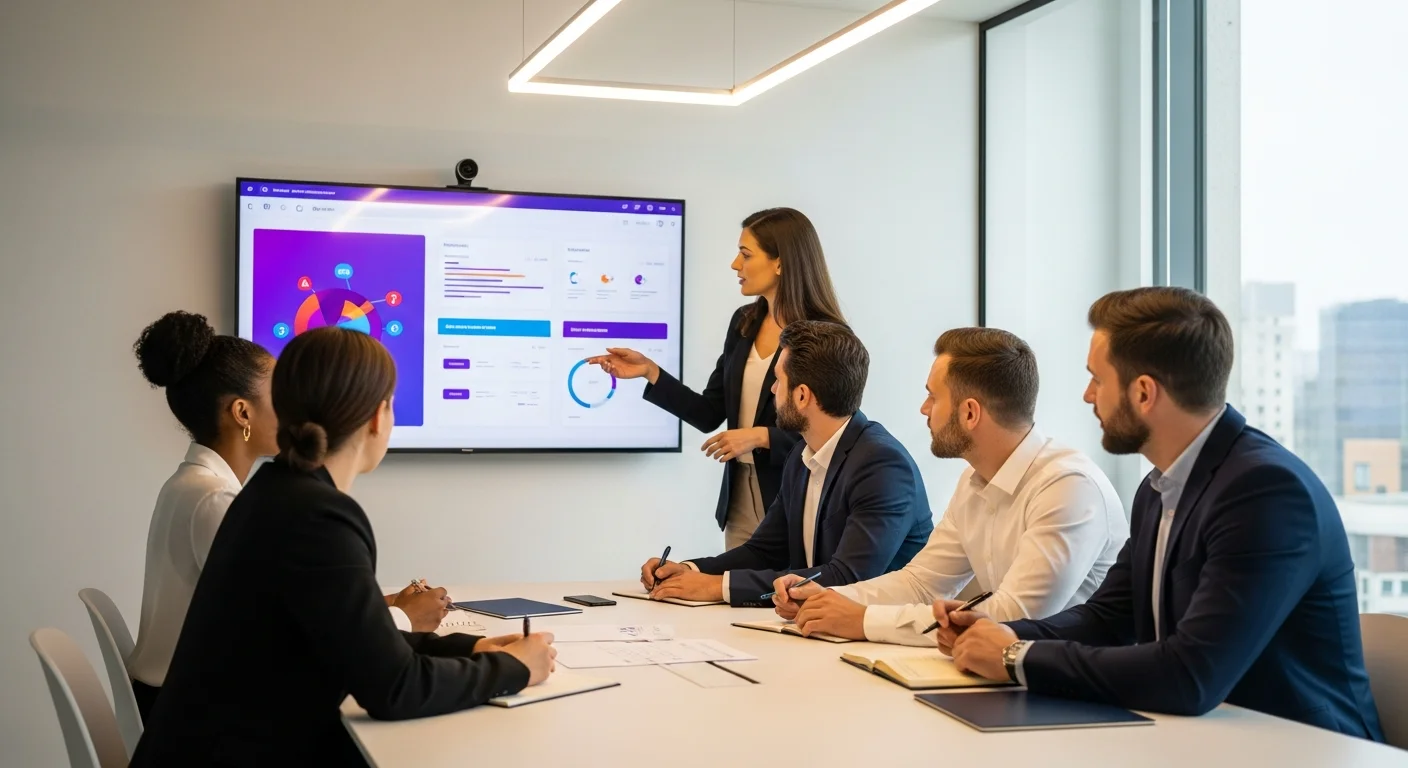
Why Meetings Fail and How to Fix Them: A Leader’s Guide
12

Most meetings are a drain on productivity, costing companies billions in lost time and morale. By understanding the root causes of meeting failure and implementing structured facilitation methods, you can turn every session into a driver of real progress.
Topics covered in this article
Adopt a 'No Agenda, No Meeting' policy to ensure every session has a clear objective and roadmap.
Transition from a 'director' to a 'facilitator' by using structured methods that encourage equal participation.
Use AI-powered tools like TeamLube to handle timekeeping and note-taking, allowing you to focus on the team.
We have all been there: sitting in a windowless conference room or staring at a grid of faces on a screen, wondering why we are here. The meeting was supposed to last thirty minutes; it is now at the hour mark, and no decision is in sight. For many leaders, meetings feel like a necessary evil—a tax on the workday that yields little return. But it does not have to be this way. When meetings fail, it is rarely because the people in the room lack talent. It is because the structure of the session lacks intention. As a manager, your job is not just to host a meeting, but to facilitate a breakthrough. This guide explores the psychological and structural reasons why meetings collapse and provides a roadmap for fixing them using modern facilitation techniques and AI-powered support.
The Hidden Cost of Unproductive Meetings
The financial impact of poor meetings is staggering. Recent studies indicate that organizations lose billions of dollars annually due to unnecessary or poorly managed meetings. For a middle manager, the cost is not just financial; it is measured in fragmented focus and delayed projects. When a meeting fails, it creates a ripple effect. Employees leave the room feeling drained rather than energized, leading to 'meeting recovery syndrome'—the time required to regain productivity after a frustrating session. This downtime can last up to 45 minutes per person, effectively doubling the actual time lost during the meeting itself.
Beyond the clock, there is a cultural cost. A culture of bad meetings signals to your team that their time is not valued. It breeds cynicism and encourages 'multitasking'—the polite term for answering emails while someone else is speaking. To fix this, we must stop viewing meetings as a default way to communicate and start viewing them as a high-stakes investment of human capital. Every minute spent in a room with ten people is actually ten minutes of company time. If you are not generating ten minutes of value for every minute elapsed, the meeting is failing. At TeamLube, we believe that recognizing this cost is the first step toward transformation. By treating every session as a structured workshop rather than a casual chat, you shift the focus from 'talking' to 'doing,' ensuring that the investment of your team's time yields a measurable return.
The 'No Agenda, No Meeting' Rule
The most common reason meetings fail is a lack of preparation. A meeting without an agenda is just a conversation with no destination. Without a roadmap, the loudest person in the room dictates the direction, and critical topics are often pushed to the final five minutes. To fix this, leaders must adopt a strict 'No Agenda, No Meeting' policy. An effective agenda is more than a list of bullet points; it is a strategic plan that outlines the objective, the required participants, and the specific methods that will be used to reach a conclusion.
When you use TeamLube, you do not have to start from a blank page. Our AI-powered agenda creation takes your high-level objectives—such as 'align on Q3 marketing spend' or 'brainstorm product features'—and builds a structured flow designed for results. This includes pre-defined time slots for divergent thinking (generating ideas) and convergent thinking (narrowing them down). By sharing this agenda 24 hours in advance, you allow your team to arrive prepared. They know exactly what is expected of them, which reduces anxiety and increases the quality of contributions. A well-constructed agenda acts as a contract between the facilitator and the participants: it promises that their time will be used efficiently and that the session has a clear purpose. If you cannot define the purpose of a meeting in two sentences, you should probably cancel it and send an email instead.
Facilitation vs. Dictation: Leading with Purpose
Many managers mistake 'leading a meeting' for 'talking the most.' This is a fundamental misunderstanding of the role. To fix failing meetings, you must transition from a dictator to a facilitator. A facilitator does not provide all the answers; they provide the environment where the team can find the answers together. When a leader dominates the conversation, the team stops thinking critically and starts waiting for instructions. This leads to 'groupthink' and missed opportunities for innovation.
Effective facilitation requires active listening and the ability to steer the conversation back to the objective when it veers off-course. This is where many leaders feel overwhelmed—it is difficult to manage the group dynamics, watch the clock, and take notes all at once. TeamLube’s AI Co-Facilitator is designed to alleviate this pressure. By acting as your 'Expert Co-Pilot,' the AI manages the timekeeping and captures the essence of the discussion, allowing you to focus entirely on the people in the room. You can ask the AI to summarize the current consensus or remind the group how much time is left for a specific activity. This support allows you to be more present, observing non-verbal cues and ensuring that the discussion remains balanced. Facilitation is about removing the friction of collaboration, and with the right tools, any manager can lead a high-impact session without needing years of specialized training.
Combatting the 'Loudest Voice' Bias
In almost every meeting, there is a natural hierarchy that emerges. The most senior person or the most extroverted individual often dominates the airtime, while quieter team members—who may have the most valuable insights—stay silent. This 'loudest voice' bias is a primary reason why meetings fail to produce diverse ideas. To fix this, you need to move away from open-floor discussions and toward structured facilitation methods. Methods like 'Brainwriting' or 'Silent Grouping' allow everyone to contribute simultaneously without the fear of being interrupted or judged.
TeamLube provides a library of over 150 proven workshop methods that are specifically designed to level the playing field. For example, instead of asking 'What does everyone think?', you can use a '1-2-4-All' structure: individuals think for one minute, discuss in pairs for two, groups of four for five, and then share with the whole room. This ensures that every single person has their ideas heard. Our dynamic custom whiteboards are generated specifically for these activities, giving participants a visual space to interact. When people can see their ideas represented as digital sticky notes or votes on a screen, they feel a greater sense of ownership over the outcome. By democratizing the contribution process, you not only get better ideas but also build a more inclusive culture where every team member feels their expertise is valued.
The Power of Timeboxing and the AI Co-Pilot
Parkinson’s Law states that work expands to fill the time available for its completion. This is why a meeting scheduled for 60 minutes will almost always take 60 minutes, even if the work could have been done in 20. To fix this, you must master the art of timeboxing. Timeboxing involves setting a strict limit for each segment of your agenda. It creates a healthy sense of urgency and prevents the group from getting bogged down in minor details that do not serve the primary objective. However, manually watching a stopwatch while trying to lead a complex discussion is nearly impossible for most managers.
This is where the TeamLube AI Co-Facilitator becomes an essential partner. During a live session, the AI monitors the progress of your agenda in real-time. It provides gentle nudges when it is time to move to the next activity, ensuring that you don't spend 45 minutes on the 'icebreaker' and only 15 on the 'strategy.' This voice-powered assistant can even capture key insights as they happen, so you don't have to stop the flow of conversation to scribble notes. By automating the administrative burden of timekeeping and note-taking, the AI allows the human leader to stay in the 'flow state' of facilitation. When a meeting is tightly timed and professionally managed, participants feel a sense of momentum. They see that progress is being made, which keeps engagement high and prevents the mid-meeting slump that often leads to failure.
Moving from Discussion to Decision
A meeting that ends without a clear decision is not a meeting; it is a waste of time. Too often, sessions conclude with a vague 'we'll circle back on this,' which is code for 'we didn't actually accomplish anything.' To fix this, every workshop must have a dedicated 'Convergence' phase where the group moves from generating ideas to making commitments. This requires a clear decision-making framework. Are we voting? Is the leader making the final call after hearing input? Or are we seeking a consensus? Without defining this upfront, the end of the meeting becomes a source of frustration.
TeamLube helps you bridge the gap between discussion and action. Our platform includes specific activities for prioritization, such as 'Impact vs. Effort' matrices or 'Dot Voting,' which help the group visually identify the best path forward. Once a decision is made, it needs to be documented immediately. The AI Co-Facilitator captures these 'Session Insights,' filtering out the noise and focusing on the actual outcomes. These insights are then ready to be exported directly into your existing project management tools like Jira, Asana, or Trello. By turning meeting notes into actionable tasks with assigned owners and deadlines, you ensure that the momentum generated in the room translates into real-world progress. This 'closed-loop' system is the hallmark of an effective leader: you don't just talk about the work; you set the work in motion.
Designing Workshops for Hybrid and Remote Teams
The rise of hybrid and remote work has added a new layer of complexity to meeting success. In a hybrid setting, those in the physical room often have a 'proximity bias,' unintentionally excluding those joining via video. Remote participants may feel like observers rather than active contributors. To fix this, you must design your sessions with a 'remote-first' mindset. This means using a centralized digital workspace that everyone can access equally, regardless of their physical location. Relying on a physical whiteboard in a conference room is a recipe for failure in the modern workplace.
TeamLube’s dynamic custom whiteboards are built for this exact scenario. Because the whiteboard is generated based on your specific agenda and methods, it provides a structured environment where everyone—remote or in-person—can contribute simultaneously. Whether it is dragging a sticky note, casting a vote, or adding a comment, the interaction is seamless and real-time. Furthermore, our AI Co-Facilitator works across the digital divide, capturing insights from the voice feed and ensuring that the digital record is accurate for everyone. This level of synchronization prevents the 'two-tier' experience that often plagues hybrid meetings. When everyone is looking at the same digital canvas and following the same AI-guided timeline, the physical distance disappears, and the focus returns to the collective goal. Effective hybrid facilitation is about creating a shared reality, and TeamLube provides the infrastructure to make that reality possible.
The Post-Meeting Void: Ensuring Follow-Through
The financial impact of poor meetings is staggering. Recent studies indicate that organizations lose billions of dollars annually due to unnecessary or poorly managed meetings. For a middle manager, the cost is not just financial; it is measured in fragmented focus and delayed projects. When a meeting fails, it creates a ripple effect. Employees leave the room feeling drained rather than energized, leading to 'meeting recovery syndrome'—the time required to regain productivity after a frustrating session. This downtime can last up to 45 minutes per person, effectively doubling the actual time lost during the meeting itself.
Beyond the clock, there is a cultural cost. A culture of bad meetings signals to your team that their time is not valued. It breeds cynicism and encourages 'multitasking'—the polite term for answering emails while someone else is speaking. To fix this, we must stop viewing meetings as a default way to communicate and start viewing them as a high-stakes investment of human capital. Every minute spent in a room with ten people is actually ten minutes of company time. If you are not generating ten minutes of value for every minute elapsed, the meeting is failing. At TeamLube, we believe that recognizing this cost is the first step toward transformation. By treating every session as a structured workshop rather than a casual chat, you shift the focus from 'talking' to 'doing,' ensuring that the investment of your team's time yields a measurable return.
FAQ
How does TeamLube help me design a meeting if I'm not a facilitation expert?
TeamLube is designed specifically for managers who aren't professional facilitators. You simply input your goals, and our AI suggests a structured agenda using our library of 150+ proven methods. It guides you through which activities to use for brainstorming, prioritizing, or decision-making, effectively giving you a 'cheat code' for expert-level workshops.
Can TeamLube integrate with the tools my team already uses?
Yes, TeamLube features deep integrations with popular project management and communication tools including Slack, Trello, Asana, Linear, Jira, Confluence, and Notion. This allows you to export your session insights and action items directly into your existing workflows without any manual data entry.
What makes a 'workshop' different from a standard meeting?
A standard meeting is often passive and discussion-heavy, whereas a workshop is active and outcome-oriented. Workshops use specific facilitation methods (like voting or mapping) to engage participants and move from divergent thinking to concrete decisions. TeamLube helps you turn every meeting into a high-impact workshop.
Is the AI Co-Facilitator recording everything we say?
The AI Co-Facilitator is designed to be a helpful assistant, not a transcription bot. It listens for key insights, decisions, and action items to help you summarize the session. It focuses on capturing the 'Session Insights' that matter, rather than creating a word-for-word transcript that no one will read.
How does the dynamic whiteboard work?
Unlike generic whiteboards, TeamLube generates a custom digital canvas based on your specific agenda. If your agenda includes a 'SWOT Analysis,' the whiteboard will automatically feature the correct template and tools for that activity, making it easy for your team to start collaborating immediately without setup time.
Can I use TeamLube for in-person meetings?
Absolutely. While TeamLube is excellent for remote and hybrid teams, it is equally powerful for in-person sessions. You can project the dynamic whiteboard onto a screen and use the AI Co-Facilitator to manage the room's energy, time, and documentation, ensuring your physical workshops are just as structured as your digital ones.
Explore more articles

Discover TeamLube
TeamLube is an AI facilitator for high-impact workshops and team events. Plan your sessions in minutes, access a library of dynamic whiteboard templates, and facilitate live sessions with confidence.
