
Async vs Sync: When Should Your Team Actually Meet?
12

Staring at a calendar that looks like a game of Tetris played by someone who hates you is a universal manager experience. We help you decide when to gather the group and when to let them stay in their flow.
Topics covered in this article
Default to async for status updates, one-way information sharing, and low-complexity feedback to protect deep work.
Reserve sync time for high-stakes decisions, emotional nuance, complex problem-solving, and team bonding.
Distinguish between meetings (passive) and workshops (active) to ensure live time is spent 'doing' rather than just 'talking.'
We have all been there. You look at your Tuesday and realize you have exactly eleven minutes of 'free time' between back-to-back calls. It is the modern manager's paradox: we want to foster collaboration, but our current meeting culture often does the opposite by fragmenting the very focus required to do great work. The tension between asynchronous (async) and synchronous (sync) communication is not just a scheduling hurdle; it is a strategic choice that defines your team's culture and productivity. At TeamLube, we believe that every minute your team spends in a live session should be high-impact. If a meeting could have been an email, it is a failure of design. If a complex workshop was attempted over a messy Slack thread, it is a missed opportunity for breakthrough. Finding the balance is about intentionality.
The Functional Difference Between Async and Sync
To master your team's schedule, you must first understand the functional divide between these two modes of work. Synchronous communication happens in real-time. It requires everyone to be present at the same moment, whether in a physical room or a digital one. This mode is high-bandwidth, meaning it carries not just words, but tone, body language, and immediate emotional cues. It is the gold standard for building trust and navigating nuance. However, it is also expensive. The cost of a one-hour meeting with eight people is not one hour; it is eight hours of collective human capital, plus the 'recovery time' needed to get back into deep work.
Asynchronous communication, on the other hand, allows for a delay between the message and the response. Tools like Slack, Notion, or recorded Loom videos allow team members to process information and respond when they are in the right headspace. This mode is the lifeblood of deep work. It respects the 'Maker’s Schedule' by preventing constant interruptions. While async can feel slower, it often leads to more thoughtful, documented, and inclusive outcomes because it gives introverts and deep thinkers the time they need to formulate their best ideas. A meeting is primarily for alignment, updates, or decisions and can function with uneven participation. A workshop is structured to produce a concrete outcome and requires active participation from everyone. In short: meetings discuss topics, workshops work through them.
When to Choose Async: Protecting the Flow State
If you find yourself reading a slide deck out loud to a group of silent people, you have officially entered the 'This Could Have Been An Email' zone. We recommend a default-to-async policy for anything that involves one-way information flow. Status updates are the primary culprit here. Instead of a thirty-minute stand-up where everyone waits for their turn to speak, try a structured Slack update or a shared document. This allows you to spot blockers faster and leaves the live time for actually solving those blockers.
Feedback on documents, designs, or code is another area where async shines. When you ask for feedback in a live meeting, you often get 'gut reactions' rather than considered critiques. By moving this to an async tool, you allow your team to sit with the material. They can provide more detailed, actionable insights that move the project forward. We also see great success with 'FYI' announcements and non-urgent policy changes being handled asynchronously. If the goal is simply to ensure everyone has the same information, a well-written post with a 'read' receipt or a simple emoji reaction is far more efficient than a calendar invite. Protecting your team's flow state is one of the most valuable things you can do as a leader. Every meeting you cancel is a gift of time back to your creators.
When to Choose Sync: The Power of Presence
There are moments when digital text simply fails. Synchronous sessions are essential when the 'emotional stakes' are high. If you need to deliver sensitive feedback, navigate a team conflict, or discuss a major pivot that might cause anxiety, you need to be in the room (or on the screen) together. The ability to see a colleague's expression and hear their tone of voice prevents the misunderstandings that plague written communication. We have all seen a harmless comment in a chat thread spiral into a 'What did they mean by that?' crisis. Sync communication is the antidote to that ambiguity.
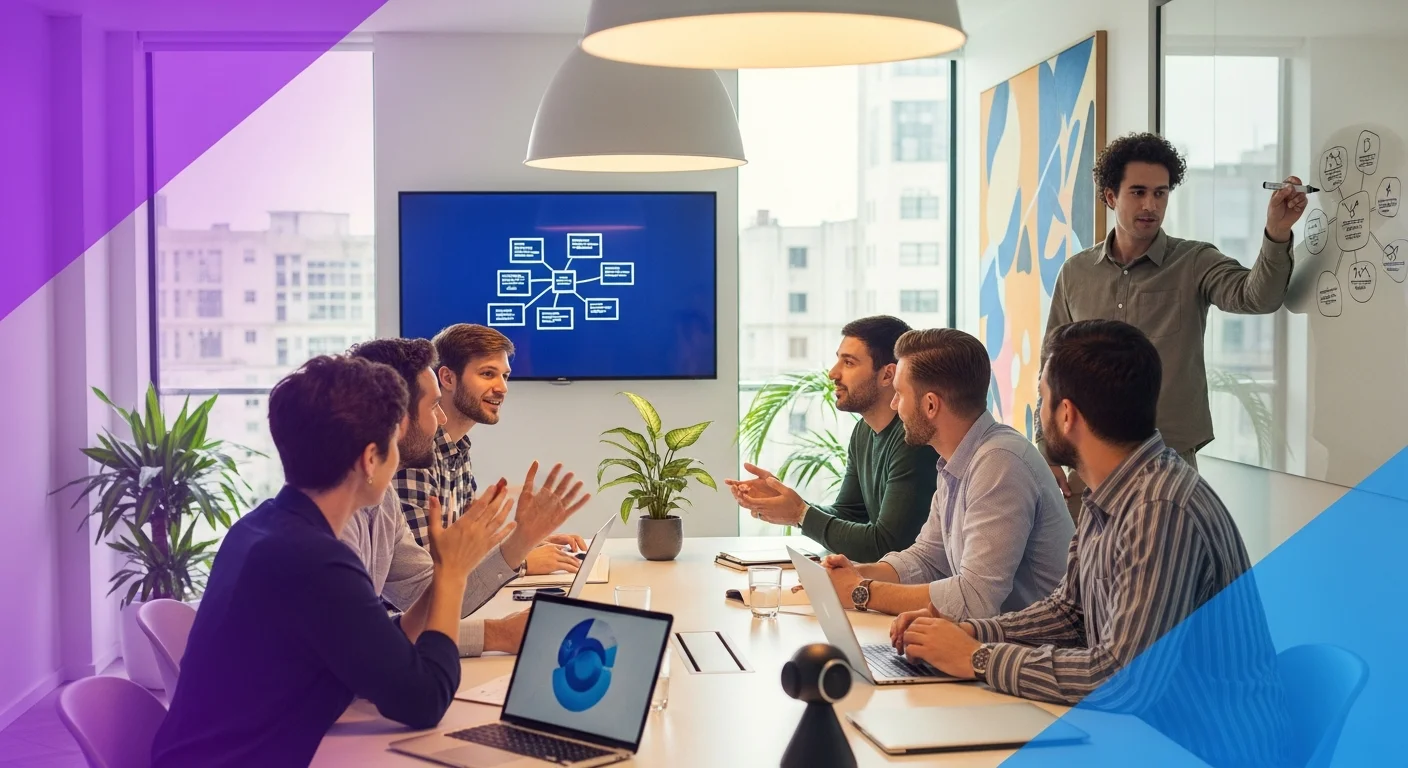
Beyond crisis management, sync is the engine of complex problem-solving. When a project hits a wall and the path forward is unclear, a structured workshop is the fastest way to find a solution. These sessions allow for the 'spark' of spontaneous ideas that rarely happens in a comment thread. Brainstorming, strategic planning, and retrospectives benefit immensely from the energy of a live group. This is where we see the most impact. By using our AI-powered agenda creation, you can ensure these sync moments are not just 'talking shops' but structured environments where decisions actually get made. If the goal is to build a shared mental model of a complex problem, you need to do it in real-time. Presence creates a level of focus and commitment that async simply cannot replicate.
The Hidden Cost of the 'Quick Sync'
The phrase 'Do you have five minutes for a quick sync?' is perhaps the most dangerous sentence in the modern workplace. While it feels efficient to the person asking, it is a massive disruption for the person being asked. Research consistently shows that it can take upwards of twenty minutes to regain deep focus after an interruption. If a manager 'pings' three team members for 'quick syncs' throughout the morning, they have effectively destroyed that team's ability to do any meaningful work before lunch. This is why we advocate for 'Synchronous Windows' or 'Office Hours' rather than ad-hoc interruptions.
When we look at team productivity, we have to look at the 'total cost of ownership' for a meeting. This includes the preparation time, the meeting itself, and the post-meeting lag. Many managers use sync meetings as a crutch because they are too lazy to write a clear brief or too disorganized to plan ahead. It is easier to 'hop on a call' than it is to think through a problem and document it. But this laziness at the top creates chaos at the bottom. By shifting to a more intentional model, you force yourself to be a better communicator. You start to value your team's time as much as your own. We designed our platform to help with this transition by making the planning phase so easy that you no longer feel the need to 'wing it' with a last-minute invite.
Meetings vs Workshops: A Critical Distinction
One of the biggest mistakes we see is teams treating workshops like long meetings. They are fundamentally different animals. A meeting is often passive; one or two people lead, and others listen and occasionally chime in. A workshop is an active session where everyone is a 'maker.' In a workshop, you are not just talking about the work; you are doing the work. This might mean mapping out a user journey, prioritizing a backlog using a specific framework, or co-writing a mission statement. Because workshops are so intensive, they require much more rigorous facilitation than a standard meeting.
This is where many managers feel out of their depth. They know they need a workshop, but they do not know how to lead one without it devolving into a circular debate. We solve this by providing over 150 curated workshop methods that guide the group through specific activities. Instead of asking 'What does everyone think?', a facilitator might use a 'Silent Brainstorming' or 'Dot Voting' method to ensure every voice is heard and decisions are data-driven. Our AI co-facilitator even helps manage the clock and capture the key insights so the manager can stay focused on the people, not the logistics. When you treat your sync time as a workshop, you transform 'talking about things' into 'getting things done.'
How AI Bridges the Gap Between Sync and Async
The biggest friction point in the async-sync cycle is the handoff. What happens after the workshop ends? Usually, the energy dissipates, the sticky notes (digital or physical) gather dust, and the team forgets what was decided within forty-eight hours. This is where AI becomes a game-changer. We believe AI should not replace the manager, but it should act as the 'connective tissue' between live sessions and daily work. Our platform captures the relevant notes and outcomes during a live session and immediately makes them useful for the async work that follows.
Imagine finishing a high-energy strategy workshop and, instead of spending two hours 'cleaning up' the notes, you simply click a button. The AI has already identified the key decisions, assigned owners to action items, and is ready to export them directly into your PM tools like Jira, Asana, or Notion. This ensures that the momentum of the sync session is not lost. It also provides a clear record for anyone who could not attend, allowing them to catch up asynchronously without feeling left out. By using voice-powered AI to steer discussions and manage time, we help managers stay in the moment while the technology handles the documentation. It is about making the sync session as productive as possible so the async work that follows is as clear as possible.
Designing Your Team's Communication Stack
A healthy team does not just 'happen'; it is designed. To find the right balance, you need to build a communication stack that clearly defines which tools are used for what. We recommend a simple three-tier approach. Tier one is for 'Immediate/Urgent' (Sync): This is for emergencies, 1:1s, and high-stakes workshops. Tier two is for 'Collaborative/Non-Urgent' (Async): This is for project updates, feedback loops, and brainstorming that does not require an immediate answer. Tier three is for 'Reference/Knowledge' (Static): This is your 'source of truth' like a wiki or a handbook where decisions are documented for the long term.
When you introduce this level of clarity, you reduce the 'notification anxiety' that plagues many teams. If a team member knows that anything in Slack is 'respond when you can' and only a calendar invite means 'I need you now,' they can plan their day with confidence. We often see managers struggle with this because they fear losing control. But the opposite is true. When you give your team the space to work, and only gather them for high-value workshops, you actually increase your influence. Your presence becomes a signal of importance, not just another notification to be ignored. Our platform supports this by integrating with your existing stack, ensuring that the outcomes of your workshops live where your team already works.
The Manager's Role as a Facilitator of Time
To master your team's schedule, you must first understand the functional divide between these two modes of work. Synchronous communication happens in real-time. It requires everyone to be present at the same moment, whether in a physical room or a digital one. This mode is high-bandwidth, meaning it carries not just words, but tone, body language, and immediate emotional cues. It is the gold standard for building trust and navigating nuance. However, it is also expensive. The cost of a one-hour meeting with eight people is not one hour; it is eight hours of collective human capital, plus the 'recovery time' needed to get back into deep work.
Asynchronous communication, on the other hand, allows for a delay between the message and the response. Tools like Slack, Notion, or recorded Loom videos allow team members to process information and respond when they are in the right headspace. This mode is the lifeblood of deep work. It respects the 'Maker’s Schedule' by preventing constant interruptions. While async can feel slower, it often leads to more thoughtful, documented, and inclusive outcomes because it gives introverts and deep thinkers the time they need to formulate their best ideas. A meeting is primarily for alignment, updates, or decisions and can function with uneven participation. A workshop is structured to produce a concrete outcome and requires active participation from everyone. In short: meetings discuss topics, workshops work through them.
FAQ
How do I transition my team from sync-heavy to async-first?
Start by auditing your current meetings. Identify recurring status updates and move them to a shared document or Slack thread for two weeks. Gather feedback from the team on how this affects their focus. Gradually introduce 'No Meeting Wednesdays' or specific 'Sync Windows' to normalize deep work periods. Lead by example—stop 'pinging' people for quick questions and use async channels instead.
What if my team feels disconnected without regular sync meetings?
Connection is about quality, not quantity. Replace three 'status update' meetings with one high-quality 'Social Sync' or a structured 'Team Retrospective' workshop. Use our 150+ methods to find activities that actually build trust and rapport rather than just filling time. When sync moments are rare and well-designed, they feel more meaningful and less like a chore.
How does TeamLube help with async follow-up?
Our platform acts as the bridge. During a live workshop, our AI co-facilitator captures key insights and decisions. Once the session ends, these are automatically organized and can be exported to tools like Slack, Jira, or Notion. This means the 'work' from the sync session immediately becomes the 'tasks' for the async period, ensuring nothing falls through the cracks.
Can I use TeamLube for in-person workshops too?
Absolutely. While we excel in remote and hybrid environments, our AI co-facilitator and agenda-building tools are just as effective in a physical conference room. You can use the voice-powered AI to keep the group on track and capture notes while everyone focuses on the whiteboard or the discussion at hand.
What are the best workshop methods for decision-making?
We recommend methods like 'Eisenhower Matrix' for prioritization, 'Dot Voting' for quick consensus, or 'Consent Decision Making' for moving forward without needing 100% agreement. Our library includes over 150 of these proven methods, each with clear instructions so you can facilitate like a pro even if you have never done it before.
Does TeamLube replace tools like Miro or Mural?
No, we complement them. While we provide dynamic custom whiteboards for your sessions, we do not aim to replace the highly specialized workflows of tools like Miro. Instead, we provide the facilitation layer—the agenda, the AI guidance, and the outcome capture—that makes any whiteboard session more effective.
Explore more articles

Discover TeamLube
TeamLube is an AI facilitator for high-impact workshops and team events. Plan your sessions in minutes, access a library of dynamic whiteboard templates, and facilitate live sessions with confidence.
