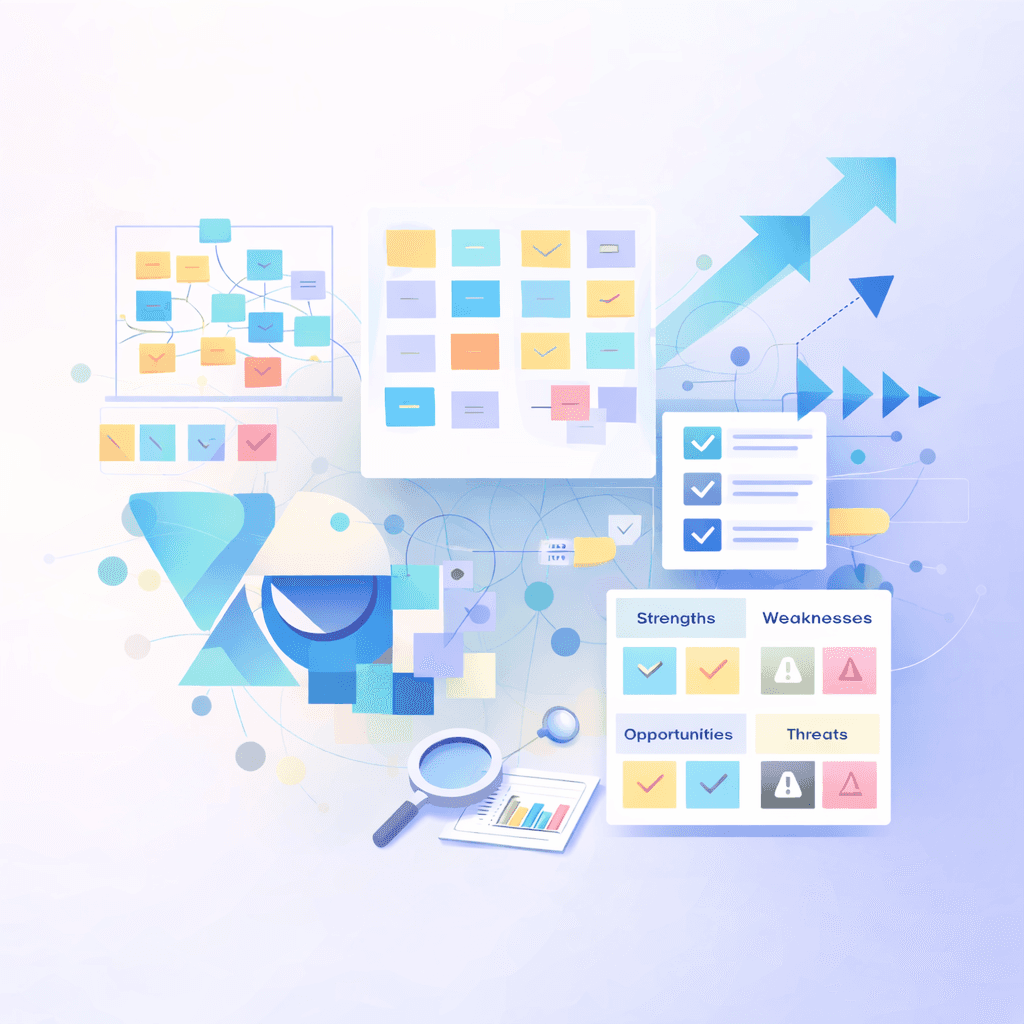
Best Workshop Methods for Team Alignment: A Manager's Guide
12

Misalignment is the silent killer of high-growth teams, leading to wasted hours and missed targets. We have curated the most effective workshop methods to help you bridge the gap between strategy and execution without needing an expensive external consultant.
Topics covered in this article
Structured workshop methods like LDJ and Team Canvas prevent 'loudest voice' bias and ensure every team member contributes to the final outcome.
Alignment is not just about goals; it requires clarity on roles, values, and personal boundaries to build long-term psychological safety.
Visual metaphors like the Sailboat exercise help teams identify hidden risks and blockers that traditional status meetings often miss.
We have all been there: a meeting that lasts ninety minutes, involves six circular arguments, and ends with everyone agreeing to 'circle back' next week. In 2026, the cost of this friction is higher than ever. Research shows that 97 percent of employees believe a lack of alignment directly impacts project outcomes. When your team is not on the same page, productivity drops, trust erodes, and your best people start looking for the exit. This guide breaks down the most effective workshop methods to transform your team from a collection of individuals into a synchronized unit. Whether you are a new manager or a seasoned lead, these techniques will help you facilitate clarity and drive results.
The High Cost of Misalignment in Modern Teams
Misalignment is rarely a loud explosion. It is a slow, quiet drain on your team's energy. In our experience, most managers realize there is a problem only when deadlines are missed or cross-functional friction becomes unbearable. Recent data from 2025 indicates that knowledge workers spend up to 42 hours per week communicating, yet nearly half of them receive confusing or unclear requests. This disconnect costs companies thousands of dollars in wasted salary hours every single month.
When we talk about alignment, we are not just talking about everyone knowing the quarterly goals. True alignment means every team member understands the 'why' behind the work, their specific role in achieving it, and the boundaries of how the team operates together. Without a structured approach, meetings often default to the loudest person in the room or the highest-paid person's opinion. This creates a false sense of agreement where people nod their heads in the room but go back to their desks feeling confused or uninspired.
Structured workshop methods solve this by leveling the playing field. They move the focus from 'who is talking' to 'what are we solving.' By using specific frameworks, you can bypass the social friction of traditional meetings and get straight to the core of the issue. At TeamLube, we have seen that teams using structured facilitation are five times more likely to be high-performing. It is about creating a repeatable process for clarity so you can spend less time managing confusion and more time leading progress.
The Team Canvas: Building a Shared Foundation
If your team feels like a group of strangers working on the same project, the Team Canvas is your best starting point. This method is designed to align a team on its core values, goals, and roles. Think of it as a business model canvas but for human collaboration. It covers nine essential blocks: Goals, Roles and Responsibilities, Purpose, Values, Rules and Activities, Strengths and Assets, Weaknesses and Risks, Needs and Expectations, and the Team Name.
Running a Team Canvas workshop helps surface the 'unspoken' expectations that often cause conflict later. For example, one person might value 'speed' while another values 'perfection.' If these values are not aligned, every code review or marketing draft becomes a battleground. By visualizing these differences on a shared board, the team can negotiate a middle ground. We recommend this method for new teams, after a major reorganization, or at the start of a significant new project phase.
To facilitate this effectively, give everyone ten minutes of silent reflection to write their thoughts for each block. This prevents 'groupthink' and ensures that even the quietest team members contribute. Once the board is filled, use our AI co-facilitator to help group similar ideas and highlight areas of disagreement. The goal is not to have a perfect document on day one, but to start a conversation that leads to a shared identity. When everyone knows exactly what is expected of them, the friction of daily coordination begins to melt away.
Lightning Decision Jam (LDJ): Speed Over Stagnation
Sometimes you do not need a deep dive into values; you just need to solve a nagging problem and move on. The Lightning Decision Jam, or LDJ, is a world-class method for rapid problem-solving and alignment. It takes a process that usually lasts days and compresses it into about 40 to 60 minutes. The beauty of LDJ is that it replaces open discussion with a structured sequence of 'Note-and-Vote' steps.
The process starts by identifying 'What is working' to build positive momentum, followed by 'Problems' or 'Challenges.' Participants then vote on the most critical problems, reframe them into 'How Might We' questions, and brainstorm solutions. Finally, the team uses an Impact-Effort matrix to decide which solutions to execute first. This prevents the team from getting bogged down in low-impact tasks that feel productive but do not move the needle.
We have found that LDJ is particularly effective for hybrid teams where long, unstructured video calls lead to 'Zoom fatigue.' Because the method relies on silent ideation and quick voting, it keeps the energy high and the focus sharp. If you are using TeamLube, our platform can automatically generate an LDJ whiteboard and manage the timers for each phase. This allows you to participate as a leader rather than just acting as a timekeeper. The outcome is a clear, prioritized list of actions that can be exported directly to your project management tools like Jira or Asana.
The Sailboat Exercise: Navigating Goals and Anchors
The Sailboat exercise is a classic facilitation method that uses a simple metaphor to help teams visualize their current state and future goals. Imagine your team is a sailboat. The 'Island' represents your goal or destination. The 'Wind' represents the things that are pushing you forward. The 'Anchors' are the things holding you back, and the 'Rocks' are the risks you might hit along the way.
This visual approach is incredibly effective for team alignment because it makes abstract concepts tangible. It is much easier for a team member to point to an 'Anchor' and say 'our outdated documentation is slowing us down' than to bring it up in a generic status meeting. By mapping out these elements, the team gains a 360-degree view of their environment. It helps move the conversation from 'what is wrong' to 'how do we cut the anchors and catch more wind.'
When facilitating the Sailboat, encourage the team to be as specific as possible. Instead of saying 'bad communication' as an anchor, ask them to define it: 'delayed responses on Slack' or 'lack of clear project briefs.' Once the anchors and rocks are identified, the team can brainstorm specific actions to mitigate them. This exercise builds a sense of shared ownership over the team's success. It is no longer 'the manager's problem' to fix the workflow; it is the team's collective mission to reach the island safely.
Liberating Structures: 1-2-4-All for Total Inclusion
One of the biggest hurdles to team alignment is the 'loudest voice' bias. In many meetings, two or three people dominate the conversation while the rest of the team checks their email. This is where Liberating Structures come in, specifically the 1-2-4-All method. It is a simple but powerful way to engage every single person in a group, regardless of their personality type or seniority level.
The method works in four quick stages. First, every individual reflects on a question or challenge for one minute (the '1'). Then, they discuss their ideas in pairs for two minutes (the '2'). Next, pairs join to form groups of four and share their best ideas for four minutes (the '4'). Finally, the whole group comes together to share the most salient insights (the 'All'). This sequence ensures that every idea is vetted and refined before it reaches the larger group, which significantly increases the quality of the final output.
Using 1-2-4-All for alignment workshops ensures that you are not just getting 'buy-in' but actual 'contribution.' When people see their ideas move from a private reflection to a group decision, their commitment to the outcome skyrockets. It is a fantastic way to align on complex topics like 'How do we improve our remote culture?' or 'What should our top priority be for the next sprint?' Our AI co-facilitator can help manage these breakout sessions, ensuring that the transitions are smooth and that the key insights from each group are captured in real-time.
ICBD: Intentions, Concerns, Boundaries, and Dreams
For teams looking for what is known as 'Radical Alignment,' the ICBD framework is an essential tool. Developed by Alexandra Jamieson and Bob Gower, this method focuses on the human side of collaboration. It asks four powerful questions: What are your Intentions for this project? What are your Concerns or what might go wrong? What are your Boundaries or what do you need to be at your best? And finally, what are your Dreams or what will be true if this goes incredibly well?
This method is particularly useful for high-stakes projects or when a team is experiencing interpersonal tension. By discussing 'Boundaries' openly, team members can share things like 'I cannot take meetings after 5 PM because of childcare' or 'I need deep work time on Tuesday mornings.' When these needs are acknowledged and respected by the whole team, it creates a foundation of psychological safety. Without this safety, true alignment is impossible because people will be too afraid to speak up when things are going off track.
Facilitating an ICBD session requires a high degree of empathy and active listening. It is not about 'fixing' someone's concerns but about hearing them. We suggest using this method at the start of every new quarter. It serves as a 'reset' button for the team's emotional health. When you combine this human-centric approach with the structured goal-setting of OKRs, you create a team that is not only aligned on the 'what' but also deeply connected on the 'how.'
Future Headlines: Aligning on a Shared Vision
Alignment is not just about the present; it is about where you are going. The 'Future Headlines' exercise is a creative way to get your team to think long-term. You ask the team to imagine it is three or five years in the future and the company has just achieved a massive success. What is the headline in a major industry publication? What does the sub-headline say? What are the key quotes from customers or employees?
This exercise helps pull the team out of the daily 'weeds' and aligns them on a shared vision of success. It often reveals that different team members have very different ideas of what 'winning' looks like. One person might imagine a headline about 'Market Dominance,' while another imagines 'Most Innovative Product.' By discussing these different versions of the future, the team can synthesize a single, inspiring vision that everyone can get behind.
To make this actionable, follow up the headline creation with a 'Backcasting' exercise. Ask the team: 'If this is our headline in three years, what must we have accomplished by next year? By next month?' This connects the big-picture dream to immediate, concrete actions. It turns a fun creative exercise into a strategic roadmap. With TeamLube, you can capture these future headlines and the resulting roadmap items, then sync them directly to your documentation in Notion or Confluence so the vision remains visible to everyone long after the workshop ends.
From Post-its to Progress: Ensuring Workshop Outcomes Stick
Misalignment is rarely a loud explosion. It is a slow, quiet drain on your team's energy. In our experience, most managers realize there is a problem only when deadlines are missed or cross-functional friction becomes unbearable. Recent data from 2025 indicates that knowledge workers spend up to 42 hours per week communicating, yet nearly half of them receive confusing or unclear requests. This disconnect costs companies thousands of dollars in wasted salary hours every single month.
When we talk about alignment, we are not just talking about everyone knowing the quarterly goals. True alignment means every team member understands the 'why' behind the work, their specific role in achieving it, and the boundaries of how the team operates together. Without a structured approach, meetings often default to the loudest person in the room or the highest-paid person's opinion. This creates a false sense of agreement where people nod their heads in the room but go back to their desks feeling confused or uninspired.
Structured workshop methods solve this by leveling the playing field. They move the focus from 'who is talking' to 'what are we solving.' By using specific frameworks, you can bypass the social friction of traditional meetings and get straight to the core of the issue. At TeamLube, we have seen that teams using structured facilitation are five times more likely to be high-performing. It is about creating a repeatable process for clarity so you can spend less time managing confusion and more time leading progress.
FAQ
Why should I use a structured method instead of just talking?
Unstructured discussions often lead to circular arguments and allow dominant personalities to overshadow others. Structured methods provide a 'level playing field' where everyone’s ideas are captured and evaluated objectively. This leads to higher-quality decisions and stronger team buy-in because everyone feels their voice was heard.
How often should we run alignment workshops?
We recommend a deep-dive alignment session at the start of every new project or quarter. Additionally, shorter 'pulse-check' workshops like a Sailboat exercise can be run monthly to identify and remove blockers before they become major issues. The key is to make alignment a regular habit rather than a reactive fix.
What if my team is resistant to 'workshop' activities?
Resistance usually comes from a history of poorly run, unproductive meetings. Start with a high-impact, short method like the Lightning Decision Jam (LDJ) to show immediate results. When the team sees that a 60-minute workshop can solve a problem that has been lingering for weeks, their resistance will quickly turn into support.
Can I run these workshops without a professional facilitator?
Yes, that is exactly why we built TeamLube. Our platform provides the structure, the methods, and an AI co-facilitator to guide you through the process. You do not need to be an expert in facilitation to run an effective session; you just need the right framework and a clear objective.
How do I choose the right method for my team's specific problem?
Focus on your primary goal. If you need to build a new team, use the Team Canvas. If you need to solve a specific bottleneck, use LDJ. If you need to align on a long-term vision, use Future Headlines. TeamLube’s AI can also recommend the best method based on the objectives you input during the planning phase.
How do we make sure the decisions we make in the workshop actually happen?
Never end a workshop without a 'Who, What, When' list. Every decision must be translated into a concrete task with an owner and a deadline. Using TeamLube, you can export these tasks directly to your project management tools, ensuring they are integrated into your team's daily work immediately.
Explore more articles


Discover TeamLube
TeamLube is an AI facilitator for high-impact workshops and team events. Plan your sessions in minutes, access a library of dynamic whiteboard templates, and facilitate live sessions with confidence.
