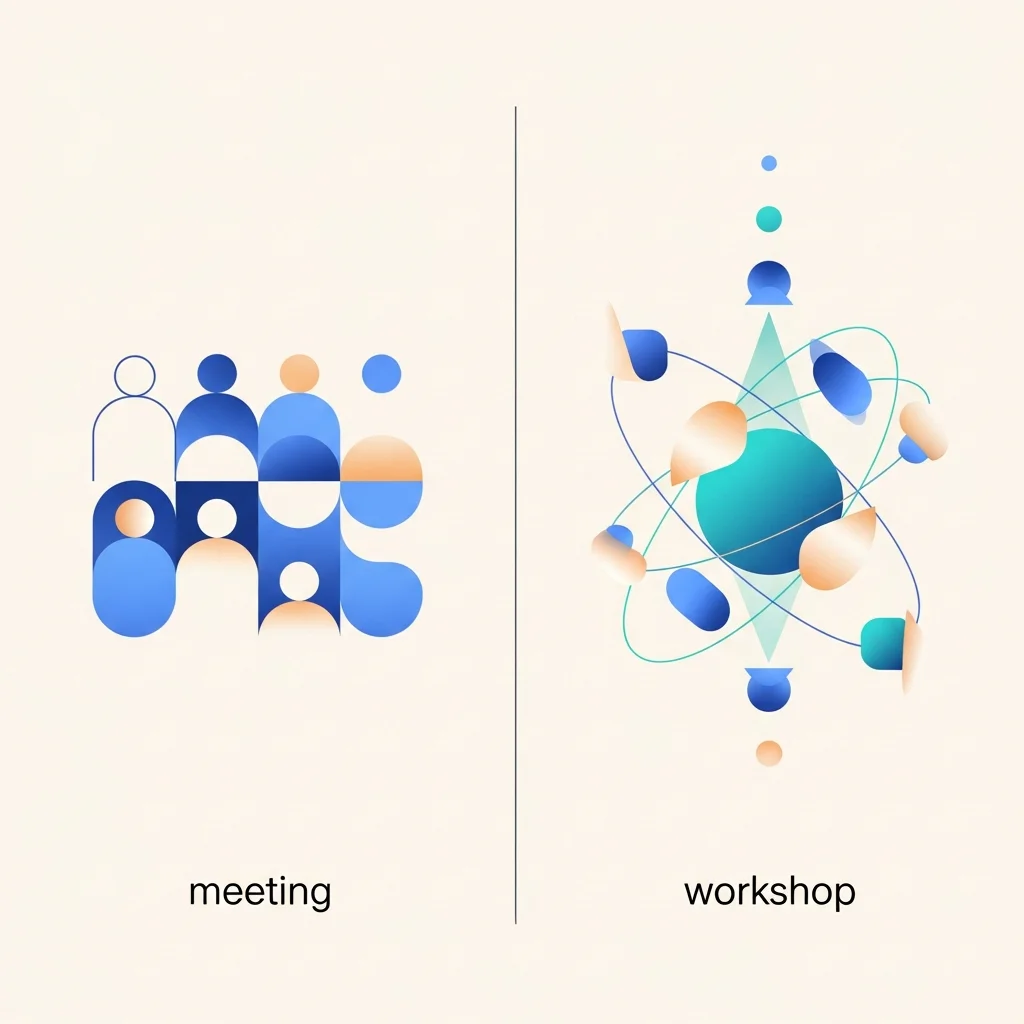
Workshop vs Meeting: What is the Difference?
12

Most managers are drowning in back-to-back syncs but starving for actual results. We break down why your next calendar invite should probably be a workshop if you actually want to get things done.
Topics covered in this article
Meetings are for information exchange and alignment; workshops are for active creation and problem-solving.
Workshops require 100% participation and structured methods to prevent dominant voices from taking over.
A workshop's success depends on a clear, tangible output (a prototype or plan) rather than just a list of discussion points.
We have all been there: staring at a calendar packed with thirty-minute syncs that feel like a slow-motion replay of last week's emails. In 2026, the average employee still spends nearly 30% of their workweek in meetings, yet a staggering 71% of senior managers report these sessions are unproductive. The problem isn't necessarily the people; it is the format. We often default to a meeting when the complexity of the task actually demands a workshop. Understanding the functional difference between these two formats is the first step toward reclaiming your team's productivity and sanity. At TeamLube, we believe that when you stop just talking and start building, the magic happens.
The Core Distinction: Discussion vs. Creation
The most fundamental difference between a meeting and a workshop lies in the verb. In a meeting, you discuss. In a workshop, you create. Meetings are designed for the transmission of information. Think of them as the 'status update' or the 'alignment sync' where the goal is to ensure everyone is on the same page. You might review a budget, hear a project update, or make a quick go/no-go decision. The cognitive load is relatively low because the primary activity is listening and reacting.
Workshops, on the other hand, are high-intensity sessions where the group works through a specific challenge to reach a predefined goal. You aren't just talking about the strategy; you are drafting the pillars of that strategy in real-time. According to data from 2025, teams that utilize structured workshops report 30% faster decision-making compared to those relying solely on traditional meetings. This is because workshops bypass the 'meeting about a meeting' cycle by forcing a tangible output before the session ends. If you leave the room with nothing but a list of 'next steps to discuss later,' you were in a meeting. If you leave with a prototype, a prioritized roadmap, or a solved problem, you just ran a workshop.
Participation Dynamics: Passive Listeners vs. Active Builders
We have all seen the 'meeting ghost': the person who joins the call, stays on mute, and clearly spends the hour clearing their inbox. In a standard meeting, this is often tolerated because the format is inherently top-down or informational. Participation is frequently uneven, with one or two dominant voices taking up 80% of the airtime. This isn't just annoying; it is a massive waste of your team's collective intelligence. Recent studies show that 73% of professionals multitask during meetings, which is a polite way of saying they aren't actually there.
Workshops flip this script. A well-designed workshop requires 100% active participation. It uses specific methods, like those in our library of 150+ facilitation activities, to ensure every voice is heard. Techniques like 'silent brainstorming' or 'dot voting' prevent the loudest person in the room from steamrolling the discussion. In a workshop, everyone has a 'pen' (digital or physical). You aren't just a recipient of information; you are a co-author of the solution. This shift from passive to active engagement is why workshops are significantly more exhausting than meetings, but also why they are infinitely more rewarding for team morale and alignment.
Structure and Facilitation: The Secret Sauce
A meeting usually follows a simple agenda: a list of topics to be covered. If the person leading the meeting is organized, they might even stick to the time slots. However, the 'how' of the discussion is often left to chance. This is why meetings so easily devolve into circular arguments or 'bikeshedding' (spending hours on trivial details while ignoring the big picture). The leader acts as a moderator, keeping the peace and watching the clock, but rarely guiding the cognitive process of the group.
Workshops require a much higher level of intentionality. They aren't just a list of topics; they are a sequence of activities designed to move the group from a state of divergence (generating ideas) to convergence (making decisions). This is where facilitation comes in. A facilitator doesn't just manage the clock; they manage the energy and the methodology. They use frameworks to help the team navigate complex problems without getting stuck. This is exactly why we built TeamLube. We know that most managers aren't trained facilitators, so our AI co-facilitator steps in to guide the process, manage the time, and ensure the team stays on track. It turns a potentially messy brainstorming session into a high-output engine.
Time and Intensity: Why Workshops Feel Different
Time is the most visible differentiator. Most meetings are squeezed into 30 or 60-minute blocks. They are designed to fit into the gaps between 'actual work.' Because they are short, they often stay at a surface level. You can't solve a deep-seated cultural issue or design a new product architecture in forty-five minutes. When you try to force workshop-level problems into meeting-level timeframes, you end up with frustration and a calendar invite for 'Part 2.'
Workshops demand a different kind of temporal commitment. They typically last anywhere from two hours to several days. This isn't because we love long sessions; it is because deep collaboration requires time to build momentum. You need time to diverge, to explore 'bad' ideas, to hit the 'groan zone' where things feel messy, and finally to emerge with a breakthrough. In 2026, we are seeing a trend toward shorter, more frequent workshops (90-120 minutes) supported by AI tools to handle the heavy lifting of documentation. This 'sprint' approach allows teams to maintain the intensity of a workshop without the burnout of a full-day marathon. It is about quality of time, not just quantity.
Outcomes: Minutes vs. Milestones
The 'minutes' of a meeting are often a graveyard of forgotten points. They record what was said, but they rarely drive what happens next. How many times have you looked at meeting notes from three weeks ago and had no idea what the actual decision was? Meetings produce 'increased awareness,' which is a fancy way of saying people heard things. While awareness is important for alignment, it doesn't move the needle on its own.
Workshops produce 'outputs.' These are tangible artifacts: a prioritized backlog, a journey map, a set of wireframes, or a signed-off project charter. The goal of a workshop is to reach a milestone. Because the work happens *during* the session, the follow-up is much simpler. You aren't trying to remember what was decided; the decision is right there on the board. At TeamLube, we take this a step further by allowing you to export these outcomes directly to your PM tools like Jira, Asana, or Notion. This bridges the gap between the 'workshop world' and the 'execution world,' ensuring that the energy generated in the session actually turns into progress.
When to Call a Meeting (and When to Run a Workshop)
Choosing the wrong format is a recipe for disaster. If you try to run a workshop for a simple status update, your team will feel patronized and annoyed by the 'forced fun' of activities. If you try to run a meeting to solve a complex cross-functional conflict, you will likely end the hour with more tension than you started with. The rule of thumb is simple: if the answer already exists and just needs to be shared, call a meeting. If the answer needs to be discovered or built by the group, run a workshop.
Meetings are perfect for: sharing news, daily standups, one-on-ones, and quick approvals. They are the 'oil' that keeps the machine running smoothly. Workshops are for: strategy setting, problem-solving, team building, and product discovery. They are the 'engine' that builds the machine in the first place. Before you send that next invite, ask yourself: 'Do I need them to hear me, or do I need them to help me?' If it is the latter, clear a larger block of time, pick a methodology, and prepare for a workshop. Your team will thank you for not wasting their time with another 'talk-shop.'
The Facilitator’s Role: Moderator vs. Guide
In a meeting, the person in charge is usually the 'chair' or 'moderator.' Their job is to keep the discussion civil, ensure everyone gets a turn to speak, and move through the agenda items. They are often the most senior person in the room, and their primary focus is on the content of the discussion. They are 'in' the conversation, often leading it and providing the most input. This works fine for simple coordination, but it is a conflict of interest when you need objective problem-solving.
In a workshop, the role shifts to 'facilitator.' A facilitator is a guide who is obsessed with the *process*, not the content. Their job is to create the environment where the team can do their best work. They stay neutral, asking the right questions rather than providing the answers. This is a difficult skill to master, especially for new managers who feel the pressure to have all the answers. This is where TeamLube changes the game. Our platform acts as your digital co-facilitator, handling the 'process' side of things (timing, method instructions, note-taking) so you can participate where it matters or step back and observe the team's dynamics. It allows you to lead without having to be the 'expert' on everything.
How TeamLube Transforms Your Sessions
The most fundamental difference between a meeting and a workshop lies in the verb. In a meeting, you discuss. In a workshop, you create. Meetings are designed for the transmission of information. Think of them as the 'status update' or the 'alignment sync' where the goal is to ensure everyone is on the same page. You might review a budget, hear a project update, or make a quick go/no-go decision. The cognitive load is relatively low because the primary activity is listening and reacting.
Workshops, on the other hand, are high-intensity sessions where the group works through a specific challenge to reach a predefined goal. You aren't just talking about the strategy; you are drafting the pillars of that strategy in real-time. According to data from 2025, teams that utilize structured workshops report 30% faster decision-making compared to those relying solely on traditional meetings. This is because workshops bypass the 'meeting about a meeting' cycle by forcing a tangible output before the session ends. If you leave the room with nothing but a list of 'next steps to discuss later,' you were in a meeting. If you leave with a prototype, a prioritized roadmap, or a solved problem, you just ran a workshop.
FAQ
What is the main difference between a meeting and a workshop?
The primary difference is the objective and the level of participation. A meeting is usually about sharing information, giving updates, or making quick decisions with a focus on 'talking.' A workshop is a hands-on session where the team 'works' together to solve a problem or create a deliverable. In a workshop, participation is mandatory and structured through specific activities, whereas meetings often allow for more passive listening.
When should I choose a workshop over a meeting?
You should choose a workshop when you have a complex problem that requires diverse input, when you need to build consensus on a new strategy, or when you want to generate creative ideas. If your goal is simply to inform the team about a change or to sync on project statuses, a meeting is more efficient. Workshops are for 'doing,' meetings are for 'aligning.'
Why do workshops feel more productive than meetings?
Workshops feel more productive because they are designed to end with a tangible output. Because they use structured facilitation methods, they prevent the common pitfalls of meetings, such as circular arguments or one person dominating the conversation. The high level of engagement and the focus on 'making' rather than 'talking' leads to a stronger sense of accomplishment and clearer next steps.
Can workshops be done remotely or in a hybrid setting?
Yes, workshops are highly effective in remote and hybrid settings when using the right tools. While traditional meetings can be draining over video, the interactive nature of a workshop keeps participants engaged. Using a platform like TeamLube, which provides dynamic whiteboards and AI co-facilitation, helps bridge the gap between physical and digital collaboration, ensuring everyone can contribute equally regardless of their location.
What role does AI play in workshop facilitation?
AI acts as a supportive co-facilitator. It helps managers design effective agendas based on their goals, recommends the best methods for their specific team context, and manages the 'logistics' during the live session. This includes keeping track of time, capturing key insights, and summarizing discussions. This allows the manager to focus on the team's energy and the quality of the work rather than the mechanics of the session.
How do I ensure my workshop doesn't just turn into another long meeting?
To prevent a workshop from devolving into a meeting, you must have a clear, predefined goal and a structured agenda with timed activities. Ensure every participant has a role and that you are using facilitation techniques that require active input (like writing before speaking). Finally, make sure the session ends with a concrete deliverable or a clear decision that was built by the group during the time allotted.
Explore more articles


Discover TeamLube
TeamLube is an AI facilitator for high-impact workshops and team events. Plan your sessions in minutes, access a library of dynamic whiteboard templates, and facilitate live sessions with confidence.
