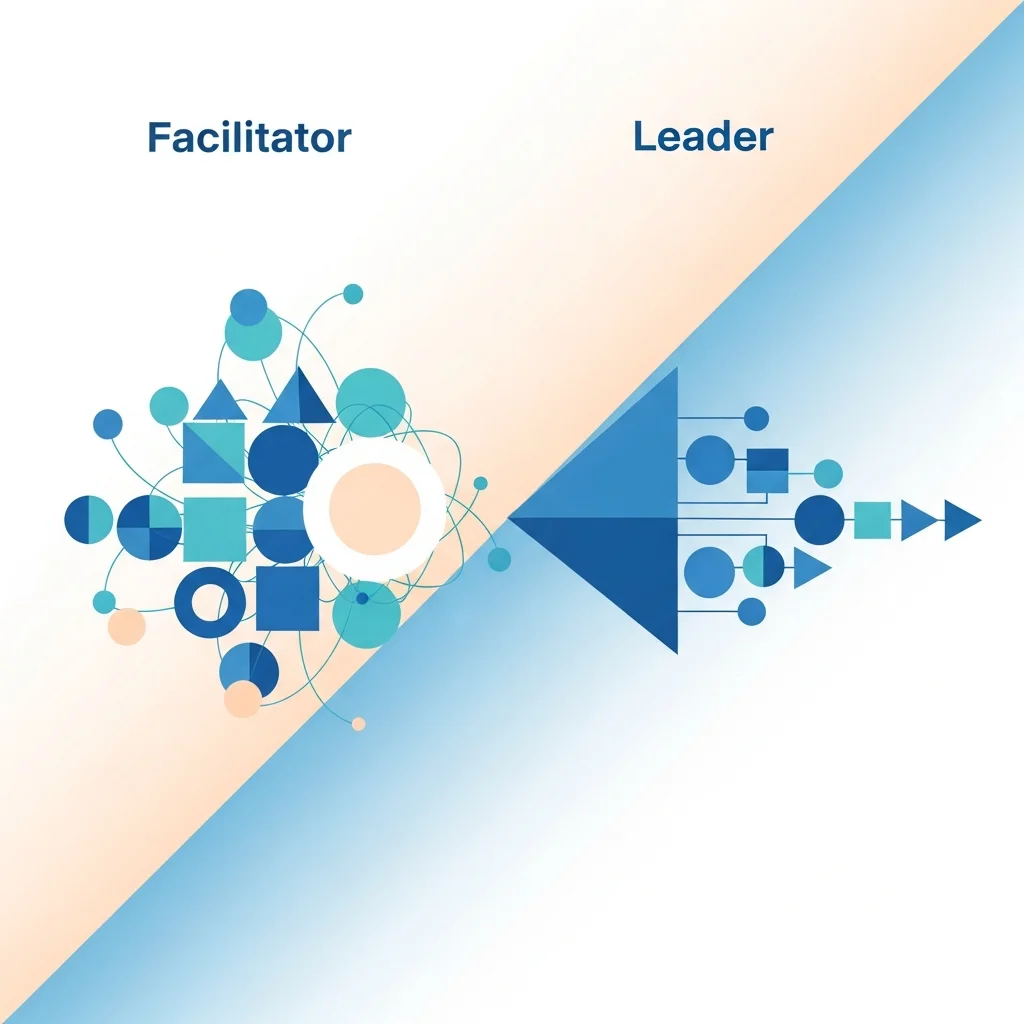
Facilitator vs Leader: Understanding the Critical Difference
12

Most managers think they are facilitating when they are actually just leading with a softer voice. We explore the functional gap between directing a team and enabling one to find its own way.
Topics covered in this article
Leaders own the content and vision, while facilitators own the process and group dynamics.
Facilitative leadership is the modern hybrid model that combines authority with inclusive guidance.
Explicitly stating which 'hat' you are wearing helps manage team expectations and participation.
We have all been in that meeting where the boss asks for honest feedback while staring intensely at their watch. That is a leadership moment masquerading as facilitation, and it usually ends in awkward silence. In the high-pressure environment of 2026, the lines between leading and facilitating have blurred, yet the distinction remains vital. Leaders often feel they must have all the answers, while facilitators know that the best answers already exist within the room. Understanding when to step forward as a visionary and when to step back as a guide is the secret to high-performance teamwork. At TeamLube, we see this struggle daily, and we are here to help you navigate it.
The Core Distinction: Content vs Process
The most fundamental difference between a leader and a facilitator lies in their focus. A leader is the owner of the content. They are concerned with the what: the strategy, the quarterly goals, and the final decision that moves the needle. When a leader speaks, the room listens because the leader carries the weight of accountability. If the project fails, the leader is the one answering to the board. This focus on content is necessary for direction, but it can often stifle the very creativity a team needs to solve complex problems.
A facilitator, conversely, is the owner of the process. They are concerned with the how. Their job is not to provide the solution but to design the path that allows the team to discover it. A facilitator manages the energy in the room, ensures that the loudest voices do not drown out the quietest ones, and keeps the discussion from spiraling into a three-hour debate about font sizes. They are the architects of the conversation, ensuring that every minute spent together is productive and inclusive.
In our experience, the most successful sessions happen when these roles are clearly defined. When a leader tries to facilitate without acknowledging their authority, the team often feels manipulated. They wonder if the facilitator is truly neutral or just leading them toward a pre-determined conclusion. True facilitation requires a level of neutrality that can be difficult for a leader to maintain, which is why understanding this content-versus-process split is the first step toward better meetings.
The Leader’s Burden: Vision and Accountability
Leadership is often romanticized as a series of heroic speeches, but in reality, it is a series of difficult choices. The leader’s primary role is to provide vision and clarity. In a world of infinite data and competing priorities, the team looks to the leader to say, This is where we are going, and this is why it matters. This visionary role is essential during times of crisis or when a team is forming and needs a clear North Star. Without a leader, a team can become a group of highly talented people rowing in different directions.
Accountability is the other side of the leadership coin. When a decision is made, the leader owns the outcome. This responsibility creates a natural bias toward the leader’s own ideas, which is perfectly human but can be a hurdle during collaborative workshops. Because the leader is on the hook for the results, they often feel a compulsive need to steer the conversation. We have seen many managers struggle with this, feeling that if they are not talking, they are not leading. In reality, the strongest leaders know when to let go of the steering wheel.
The leader also acts as the final arbiter. While a facilitator might help a group reach a consensus, the leader is the one who must sign off on it. This authority is a powerful tool, but it must be used sparingly. If a leader constantly overrides the group’s collective intelligence, the team will eventually stop contributing. They will simply wait for the leader to tell them what to do, which is the fastest way to kill engagement and innovation in any organization.
The Facilitator’s Art: Neutrality and Flow
If the leader is the sage on the stage, the facilitator is the guide on the side. The facilitator’s greatest strength is their neutrality. They do not have a horse in the race, or at least they act as if they do not. Their success is measured not by the specific decision made, but by the quality of the process used to get there. A facilitator asks the powerful questions that a leader might be too biased to ask. They probe for underlying assumptions and challenge the group to think beyond the obvious.
Managing the flow of a session is a delicate art. It involves reading the room and noticing when the energy dips or when a conflict is brewing beneath the surface. A skilled facilitator uses specific methods, like the 1-2-4-All technique, to ensure that everyone has space to think individually before sharing with the group. This structure prevents groupthink and ensures that the best ideas rise to the top, regardless of who they came from. It is about creating a level playing field where the merit of an idea outweighs the title of the person who suggested it.
Facilitators also act as the guardians of time. We all know the pain of a meeting that spends forty-five minutes on the first agenda item and five minutes on the most important one. A facilitator prevents this by keeping the group focused and moving. They are the ones who gently interrupt a tangent and say, That is a great point, let us put it in the parking lot so we can stay on track. This discipline allows the team to feel a sense of progress, which is one of the most significant drivers of workplace satisfaction and engagement.
The Hybrid Model: Facilitative Leadership in 2026
The traditional command-and-control model of leadership is rapidly becoming a relic of the past. In 2026, the most effective managers are those who have mastered facilitative leadership. This hybrid approach involves knowing when to lead with authority and when to facilitate with curiosity. It is a shift from being the person with all the answers to being the person with the best questions. Facilitative leaders understand that their primary job is to unlock the potential of their team members rather than just directing their tasks.
This model is particularly effective in hybrid and remote environments where traditional cues of authority are less visible. In a Zoom or Teams room, a leader who only dictates will quickly lose the attention of their team. A facilitative leader, however, uses digital tools and structured activities to keep everyone engaged. They might use an AI-powered agenda to ensure the session is balanced or a voice-powered co-facilitator to manage the technical aspects of the meeting while they focus on the people. This allows the leader to be present and empathetic without being overwhelmed by the logistics.
Research from 2025 and 2026 suggests that teams led by facilitative leaders report higher levels of psychological safety and lower rates of burnout. When employees feel that their input is genuinely valued and that they have a hand in shaping the team’s direction, their commitment to the outcome increases exponentially. Facilitative leadership is not about being soft or avoiding decisions; it is about building a culture of shared ownership where the team is empowered to do their best work.
When to Switch Hats: A Practical Guide
Knowing which hat to wear is a skill that takes practice. There are times when your team desperately needs a leader, and times when they need a facilitator. For instance, during a company-wide crisis or a sudden shift in market conditions, the team needs a leader. They need someone to step up, provide a clear direction, and make quick, decisive calls. In these moments, trying to facilitate a consensus-based discussion can feel like a waste of time and can actually increase the team’s anxiety.
On the other hand, when you are brainstorming a new product feature, solving a complex cross-functional problem, or conducting a project retrospective, you should be in facilitator mode. These are scenarios where the collective intelligence of the group is far superior to any single individual’s perspective. Your goal here is to extract as many diverse ideas as possible and help the group synthesize them into a coherent plan. If you lead too strongly in these sessions, you risk missing out on the breakthrough idea that someone was too intimidated to share.
A good rule of thumb is to look at the complexity of the task. If the path forward is clear and only needs execution, lead. If the path is murky and requires creative problem-solving, facilitate. We often suggest that managers explicitly state which hat they are wearing at the start of a meeting. Saying something like, For the first half of this session, I am going to facilitate our brainstorming, and in the second half, I will step back into my leader role to make the final selection, provides the team with the clarity they need to participate fully.
The Leader-as-Facilitator Trap
One of the most common pitfalls we see is the leader who thinks they are facilitating but is actually just conducting a very long, very polite interrogation. This happens when a leader asks open-ended questions but clearly has a specific answer in mind. The team quickly picks up on this and starts playing a game of Guess what the boss is thinking. This is not facilitation; it is a performance, and it is exhausting for everyone involved. It destroys trust and makes future attempts at genuine collaboration much harder.
Another trap is the lack of neutrality. It is incredibly difficult for a manager to remain neutral when the topic affects their own department’s budget or reputation. In these cases, the leader’s bias will inevitably leak out through their body language, their tone of voice, or the way they summarize the group’s points. Even a subtle nod of approval for one idea over another can signal to the group which way the wind is blowing. This is why many high-growth companies are now using AI tools to provide a neutral framework for their discussions.
Finally, there is the trap of the loudest voice. Without a structured facilitation process, the most extroverted or senior people in the room will dominate the conversation. A leader who is trying to facilitate might feel that they are being inclusive just by letting people talk, but if they are not actively managing the dynamics, they are failing. True facilitation requires the courage to interrupt the talkers and the patience to wait for the thinkers. It is about ensuring that the outcome is a reflection of the entire group’s wisdom, not just a loud minority.
How AI Bridges the Facilitation Gap
The biggest barrier for managers who want to facilitate more effectively is the cognitive load. Planning a workshop, managing the time, capturing notes, and staying present in the discussion is a lot for one person to handle. This is where AI becomes a game-changer. At TeamLube, we designed our platform to act as a supportive partner that takes the logistical weight off your shoulders. By using an AI-powered agenda creator, you can ensure your session is built on proven methods without having to spend hours researching facilitation techniques.
During the live session, a voice-powered AI co-facilitator can manage the clock and capture relevant insights in real-time. This allows the manager to focus entirely on the human elements of the discussion, like reading the room and encouraging participation. The AI does not make decisions for the team, but it provides the structure that makes decision-making easier. It is like having a professional facilitator sitting next to you, whispering reminders and keeping the process on track while you lead your team toward their goals.
This technology also helps maintain neutrality. When the AI is the one tracking the time or summarizing the points, it removes the perceived bias of the leader. The team sees a transparent, data-driven process that they can trust. This transparency is crucial for building a culture of alignment and accountability. By delegating the process to a tech-enhanced partner, managers can finally bridge the gap between leading and facilitating, becoming the effective, modern leaders their teams deserve.
Measuring Success: Outcomes vs Engagement
The most fundamental difference between a leader and a facilitator lies in their focus. A leader is the owner of the content. They are concerned with the what: the strategy, the quarterly goals, and the final decision that moves the needle. When a leader speaks, the room listens because the leader carries the weight of accountability. If the project fails, the leader is the one answering to the board. This focus on content is necessary for direction, but it can often stifle the very creativity a team needs to solve complex problems.
A facilitator, conversely, is the owner of the process. They are concerned with the how. Their job is not to provide the solution but to design the path that allows the team to discover it. A facilitator manages the energy in the room, ensures that the loudest voices do not drown out the quietest ones, and keeps the discussion from spiraling into a three-hour debate about font sizes. They are the architects of the conversation, ensuring that every minute spent together is productive and inclusive.
In our experience, the most successful sessions happen when these roles are clearly defined. When a leader tries to facilitate without acknowledging their authority, the team often feels manipulated. They wonder if the facilitator is truly neutral or just leading them toward a pre-determined conclusion. True facilitation requires a level of neutrality that can be difficult for a leader to maintain, which is why understanding this content-versus-process split is the first step toward better meetings.
FAQ
What is the biggest challenge for a leader trying to facilitate?
The biggest challenge is maintaining neutrality. Because leaders are ultimately accountable for the results, they often have a strong personal bias toward certain outcomes. This can lead to 'leading the witness' where the facilitator subtly steers the group toward their own preferred solution, which undermines the entire purpose of facilitation and can damage team trust.
How does TeamLube help a manager who has never facilitated before?
TeamLube provides an end-to-end support system. It uses AI to generate a structured agenda based on your specific goals, recommends proven workshop methods from a library of 150+ activities, and offers a voice-powered AI co-facilitator during the live session. This handles the 'how' of the workshop, allowing the manager to focus on the 'who' and the 'what' without needing years of facilitation training.
Is facilitation only for large workshops?
Not at all. Facilitation techniques can be applied to any group interaction, from a 15-minute daily stand-up to a multi-day strategic offsite. Even in small team meetings, using a structured process to ensure everyone speaks or to prioritize ideas can significantly improve the quality of the discussion and the speed of decision-making.
Does using an AI facilitator replace the need for a human leader?
Absolutely not. AI is a tool that supports and guides the process, but it cannot replace human leadership, empathy, or intuition. TeamLube is designed to empower managers to be more effective, not to make decisions for them. The human leader still provides the vision, builds the relationships, and carries the final accountability.
How do I deal with a team member who dominates the conversation?
This is a classic facilitation challenge. You can use structured methods like 'Silent Brainstorming' where everyone writes their ideas down before anyone speaks, or 'Round Robin' where each person has a set amount of time to share. You can also use the AI co-facilitator to track speaking time, which provides a neutral way to encourage more balanced participation without making it feel personal.
What is the difference between a meeting and a workshop?
A meeting is primarily for alignment, updates, or simple decisions and can often function with uneven participation. A workshop is a structured session designed to produce a concrete outcome through active collaboration. In short: meetings are for discussing topics, while workshops are for working through them to reach a specific goal.
Explore more articles


Discover TeamLube
TeamLube is an AI facilitator for high-impact workshops and team events. Plan your sessions in minutes, access a library of dynamic whiteboard templates, and facilitate live sessions with confidence.
